
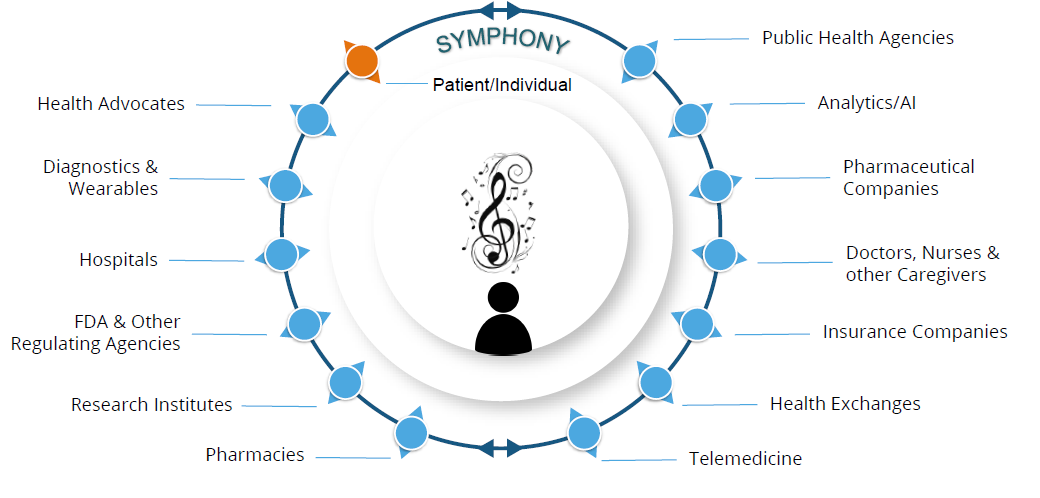
Back in 2019, we ran a project we called “Symphony” alongside three blockchain pioneers, driven by a bold vision: to empower patients with full control over their health data through a personal data wallet. The goal was to let individuals decide who could access their records — and even monetize that access if desired. We built an app leveraging SMART-on-FHIR to securely pull data from an Epic endpoint, using a HAPI FHIR server to deidentify sensitive information. We joined forces with the Hyperledger healthcare working group, hoping to align with emerging standards in decentralized health data. But despite a year of intense development and research, we ran into formidable barriers — most notably HIPAA and GDPR compliance — and ultimately had to sunset the project.
Market Research – Personal Health Records (PHR) Apps
Now, six years later, I revisited the landscape to see how others have fared. Surprisingly, many blockchain-based health data ventures struggled to gain traction, especially compared to platforms like Apple Health and Epic’s MyChart, which already had privileged access to health or clinical data and didn’t rely on decentralized infrastructure. Below is an excerpt our market research, and here is the complete comparative table of 43 companies supporting Health Data Wallets. The list does not include companies supporting “Data Visiting” (DV). Reasons for this absence are discussed below.
| Name | Year Started | Type | Region | 2025 Status | 2025 Update |
|---|---|---|---|---|---|
| Coral Health | 2017 | Blockchain | Canada | Closed | Shut down quietly; aimed to use blockchain for personalized medicine but lacked traction. |
| Patientory | 2015 | Blockchain | United States | Still in business | One of the first HIPAA-compliant blockchain EHR platforms; active in healthcare consortiums. |
| Encrypgen | 2017 | Blockchain | United States | Closed | Pioneered genomic data marketplaces; closed due to regulatory and adoption challenges. |
| MedicalChain | 2017 | Blockchain | United Kingdom | Still in business | Used blockchain for telemedicine and consent; partnered with NHS pilots. |
| Luna DNA | 2017 | Blockchain | United States | Closed | First SEC-approved company to offer equity for genomic data; shut down in 2024. |
| Nebula Genomics | 2018 | Blockchain | United States | Acquired | Acquired by ProPhase Labs; offered whole genome sequencing with privacy-first model. |
| PokitDok | 2011 | Blockchain | United States | Acquired | Acquired by Change Healthcare; known for DokChain and healthcare APIs. |
| doc.ai | 2016 | Blockchain | United States | Still in business | Acquired by Sharecare; ran AI-powered clinical trials and data aggregation. |
| Briya | 2021 | Blockchain | Israel | Still in business | Uses federated learning and blockchain for secure health data exchange. |
| Avaneer Health | 2020 | Blockchain | United States | Still in business | Founded by major payers; uses blockchain and FHIR for interoperability. |
| Embleema | 2017 | Blockchain | United States | Still in business | Partnered with FDA for blockchain-based clinical trial data sharing. |
| Curisium | 2016 | Blockchain | United States | Still in business | Acquired by Merck; focused on value-based contracts using blockchain. |
| Solve.Care | 2017 | Blockchain | Estonia (Global operations) | Still in business | Global operations; built Care.Wallet and partnered with governments. |
| CareChain | 2018 | Blockchain | Sweden | Still in business | Focuses on patient-controlled health data and interoperability. |
| Apple Health | 2014 | Cloud+Apps | Global | Still in business | Integrates with Apple Watch; supports EHR access via Health Records API. |
| MyChart | 2003 | Cloud+Apps | United States | Still in business | Epic’s patient portal; widely adopted across U.S. health systems. |
| MyID | 2019 | Cloud+Apps | Australia | Still in business | Emergency medical ID app; integrates with wearables and QR codes. |
| My Health Records | 2015 | Cloud+Apps | United States | Still in business | Powered by PrognoCIS; supports secure messaging and lab access. |
| Microsoft HealthVault | 2007 | Cloud+Apps | United States, United Kingdom, Canada (Closed) | Closed | First major PHR platform; shut down in 2019 due to low adoption. |
| Google Health | 2008 | Cloud+Apps | Global | Closed | Multiple relaunches; now integrated into Fitbit and Android Health Connect. |
| CareZone | 2012 | Cloud+Apps | United States | Acquired | Acquired by Walmart in 2020; had 3.5M users managing prescriptions. |
| HealthLoop | 2009 | Cloud+Apps | United States | Acquired | Acquired by GetWellNetwork; pioneered automated post-discharge check-ins. |
| WellDoc | 2005 | Cloud+Apps | United States, India | Still in business | BlueStar app was first FDA-cleared mobile diabetes management tool. |
I also explored whether the concept of “data visiting” — where apps analyze health data in place without extracting it — has made its way into real-world solutions. So far, the answer is no: while the idea is gaining momentum in academic circles and pilot initiatives, there are still no mainstream, market-ready technologies that fully realize this vision of a patient-controlled health data space with in-place analytics.
Why Data Visiting is Still Experimental
- Technical complexity: True in-place analysis requires secure sandboxing, encrypted computation, or federated learning — technologies that are still maturing.
- Regulatory hurdles: HIPAA, GDPR, and other frameworks make decentralized data access tricky without centralized oversight.
- Healthcare inertia: Most systems still rely on centralized EHRs and data silos, making interoperability and patient control difficult.
- Business models: Many health apps and platforms rely on data aggregation for monetization, which conflicts with the “data visiting” paradigm.
Examples That Are Close — But Not Quite There
- Andaman7: Offers decentralized PHR with AI features; launched Version 5 in 2024, with no news since then.
- A Samsung-backed blockchain PHR app demonstrated high usability and consent management with a paper in 2022.
- Apple Health Records: Lets patients view and share data, but apps still pull data out for analysis.
- OneRecord: Aggregates data via FHIR APIs, but doesn’t support in-place computation.
- Ocean Protocol + Health Wallets: Promising architecture for data visiting, but still in research phase since 2022.
- Federated Learning in Healthcare: Used in research (e.g., for cancer prediction), but not yet consumer-facing or integrated into PHR apps.


Bottom Line
The idea of a “health data wallet” with data visiting is visionary and aligns with modern privacy-first computing — but it’s not yet a reality in mainstream healthcare. What we have today are aggregators, portals, and apps that offer partial control, but still rely on data movement rather than in-place analysis.